Abstract
Change in climatic patterns is not a recent but a historical phenomenon. For instance, people used to cut trees in ancient Greece, believing such an act would bring rainfall. It is agreeable that the earth’s climate has excessively changed over thousands of years. However, recent changes in climatic patterns have resulted in more harm than good. Over the years, scientific research has continuously pointed out evolving climate patterns such as rainfall fluctuation and global warming. These trends have culminated in what many people now refer to as climate change. The effects of climate change vary across different geographical and climatic regions worldwide. This scenario makes it crucial to examine the causes, impacts, and mitigation from a more narrow view, as those factors vary according to a different context. Arguably, narrowed studies on climate change would result in more feasible mitigation strategies and solutions. This paper aims to examine climate change in California as one of the states currently experiencing impacts stemming from climate change. In understanding climate change in California, it is vital to explore the causes, the implications, and the current mitigation strategies adopted to alleviate the crisis.
Introduction
As noted by (Rust), climate change did not just occur out of nowhere, nor did the earth decide to start behaving abnormally. Arguably, it has taken centuries or even millenniums for the current climatic trends to occur. Many people would agree that climate change is a result of human activities. Studies indicate that these changes commenced with industrialization. Industries initiated carbon dioxide emissions and environmental destruction that ultimately led to the emergence of climate change. This background provides a solid foundation for investigating the causes of global warming in California.
GHG emissions
Carbon dioxide emissions remain one of the principal causes of global warming. The consumption of fossil fuels in industrial activities and transport releases harmful gases into the atmosphere, leading to the greenhouse effect. As noted by (Samir & Marco), California is one of the states on the frontline in instituting measures in curbing carbon dioxide emissions. Such policies target the transport and industrial sectors as the two are the largest carbon dioxide-producing agents. Even with these policies, much of the state’s energy comes from fossil fuels. Carbon dioxide takes up much of the greenhouse gases (Robert). According to (IPPC) Carbon dioxide levels have increased by 40% compared to before industrialization. It is crucial to note that greenhouse gases do not emanate only from industrial and transportation activities. Agriculture involves the consumption of fossil fuels, chemicals like fertilizers that host greenhouse gases like Nitrous Oxide. Besides, livestock production leads to the emission of harmful gases such as methane. Also, studies have established the presence of methane emissions in rice fields. Even though other greenhouses exist in small quantities, they are more effective at trapping heat than Carbon dioxide. The changes witnessed in California are partly a result of greenhouse gas emissions.
Deforestation
Destruction of forests is a rampant phenomenon in the modern era. Typically, forest destruction stems from a myriad of natural and human factors. According to (Bennet et al), only 31% (slightly over 4 billion hectares) of the earth’s surface is covered by forest compared to 5.4 billion hectares existent before industrialization. As noted by (Seymour et al.), deforestation was rampant in the 1990s, with an estimated 16 million annual forest loss. Over the years, California has lost vast tracts of forest cover due to diverse causes. Besides, the burning of wood fuel obtained from cleared forests fire contributes to the increasing greenhouse gases in the atmosphere. Redwood poaching has significantly harmed Californian forests. Redwood poaching has rapidly increased in recent years to the extent of being compared with game poaching. Although human activities are a dominant cause of deforestation, natural causes also exist. As noted by (Gorte & Sheikh), the forests along the Californian coastline display a receding trend resulting from a phenomenon termed tree death. Environmental specialists say tree death is a pathogenic agent that attacks oak trees. This phenomenon has led to the loss of countless oak trees and a disruption in the ecosystem. Although the government has investigated this problem, no current solution is available for curbing tree death. Forest fires are one of the pivotal agents of deforestation in California. More than human activities, forest fires have resulted in massive destruction of trees and loss of biodiversity. As noted by (Liu et al.), forest fires cause vast emissions of greenhouse gases into the atmosphere, like human activities. Landslides usually occur after a period of heavy rainfall. As noted by (Ren et al), landslides harbor both positive and negative impacts. Although they help move fertile soil into other areas for farming, they also destroy trees.
Evidence and Impacts of Climate Change in California
In light of the causal factors discussed above, it is agreeable that some factors causing climate change in California are well beyond human control. However, the impacts weigh heavily on the environment and health of California. In further examining the issue, it is vital to analyze the experiences stemming from climate change recently witnessed in the state.
Scorching temperatures
Research suggests that the global temperatures witnessed in recent years are much higher than in preceding decades. The reason is the continuous destruction of the environment, global warming, and climate change. According to (Rust), the current temperatures in California are more than two times warmer than in 1970. With the current global emissions, the levels will increase four times the current state by the end of this century. With temperatures rising above 100 degrees, the trend is worrying. Although some months like august are relatively warm in California, research indicates that the current temperatures are way above normal levels due to global warming and climate change. Typically, excessive temperatures make weather unfavourable. However, heat waves bear more adverse implications on health. As noted by (Shonkoff et al.), the heat waves in California are the prime cause of the increasing heatstroke cases among children and the elderly. Other complications resulting from high temperatures include respiratory problems, cardiovascular issues, and dehydration. According to (Liu et al.), the impoverished population is highly vulnerable to these health implications since they cannot afford proper housing or equipment to help them fight the soaring temperatures. Recent studies reveal that minority communities and people with underlying illnesses living in California make up a higher portion of the people affected by this problem. Unfortunately, the health implications discussed will increase or worsen if global emissions are unchecked.
Water problems
Studies on climate change have always linked the phenomenon with water. Globally, climate change has disrupted rainfall patterns, resulting in low rainfall, droughts, and floods. In California, the Sierra Nevada Snowpack is an essential water supply organ. During winter, the snowpack holds vast snow that melts slowly to supply water during summertime when it is most required. In previous decades, the Sierra Nevada snowpack melted gradually, resulting in a smooth and regulated water supply to tanks and dams in California (Aldaron). Due to rising temperatures, the snow melts more rapidly than before, leading to surges in the water supply and the risk of floods and water shortages.
Forest fires
As noted by (EPA), forest fires are among California’s worst climate change effects. Due to rising temperatures, the soil and vegetation have dried up. Environmental experts point out that forest fires are part of California’s history. However, climate change has worsened the problem. As noted by (Rust), recent forest fires are fiercer and last more than two times longer than in the last decade. As stated, research establishes that as temperatures increase, soil moisture diminishes more rapidly, leading to heat waves, withering and drying of vegetation, and the risk of the ferocious fires witnessed in the West. Although ineffective forest management and human activities are some of the causes of the disastrous fires, it is agreeable that climate change creates an environment for the destructiveness brought forth by the fires. As (Rust) puts it, dry conditions set the pace for forest fires.
Air pollution
It is agreeable that air is one of the world’s crucial resources. Without it, human existence is impossible. However, with recent industrial and technological advances, air pollution has increased. Concerning climate change, air pollution stems from greenhouse gas emissions that contaminate the air with harmful chemical compounds like Nitrous oxide and Carbon dioxide. Air pollution is rampant in California. Since it is a developed city, vast amounts of fossil fuels are consumed in industry and transportation. According To (Ganesh & Jason), out of the ten most air-polluted cities in the U.S., five are in California. Major air pollutants include Nitrous Oxide and chemically unidentified particulate materials. As earlier stated, forest fires add to air pollution by producing smoke and particles that later form smog. According to (Liu et al.), forest fires in California will increase, resulting in a “smoke wave.” Besides, such fires and smoke waves will adversely affect human health. Presently, air pollution in California is the chief cause of premature deaths, respiratory and cardiovascular diseases among the population inhabiting urban and suburban areas.
Rising sea levels
One of the critical concerns raised by climate change experts is the rapidly rising sea levels due to the melting of ice glaciers in the Arctic. An estimated 85% of Californians live or work along the state’s coastline. The Californian sea level has risen by more than 8 inches in the past century. Studies project that it will increase to 55 inches by the end of this century (EPA). Such a sea level will inevitably lead to coastline flooding, loss of life, and property worth billions. Globally, the rising sea levels threaten tourism and coastal economies, which are highly dependent on the oceans. Additionally, it will contaminate freshwater sources in California like the San Joaquin delta leading to shortages of safe drinking water. Besides, seawater will severely destroy crops and farmlands located near the coastline.
Influence on agriculture
The world depends on agriculture in feeding its populations. Agriculture remains one of the sectors worst hit by the effects of climate change. In California, the agricultural sector is threatened by floods, pests, droughts, and seawater contamination (Shonkoff). The current rise in temperatures affects crop growth resulting in lower yields increasing the risk of food shortages. It is critical to note that other states also depend on California for food; hence, interventions are crucial in averting this impending disaster (EPA). Deterioration of agriculture will lead to unemployment for a section of the population serving in the industry.
Demand for electricity
In adapting to the current escalating temperatures, it is vital to install cooling mechanisms in residential premises (Chang et al.). These include fans, air conditioners, and ventilation systems. Alternatively, house construction plans must consider ventilation as heat levels will rise. All cooling equipment uses electricity, so household demand for electricity will increase. High electricity demand will strain the available resources, increasing power prices. Studies indicate that the current electricity demand in Southern California will rise by 60% (Shonkoff et al.).
Loss of biodiversity
One of the most critical impacts of climate change is biodiversity loss. Over the years, climate change alterations have led to the extinction of hundreds of animal and plant species. California is recognized globally for its biodiversity. It is the most ecologically diverse region among all the U.S.A. (EPA) states. All the impacts of climate change discussed in this paper result in ecological disruption, death, and extinction of many animals, plant, and fish species.
Mitigation strategies
As much as the impacts of climate change are unstoppable and inevitable, governments and organizations worldwide remain active in mitigating the present crisis and securing the future of humanity. Reducing GHG emissions is a useful strategy in mitigating the impacts of climate change. Global policies regulating carbon dioxide emissions are active across many countries. According to (Roberts), California initiated climate change policies as early as 2006 by enacting the AB32 legislation that preceded other regulations on greenhouse gas emissions in the state. According to recent statistics, the state economy has significantly grown while maintaining safe levels of GHG (Robert). A 12% drop in emissions shows good progress in alleviating the impacts of climate change. As shown on the graph below, California displays a good trend in eradicating GHG emissions.
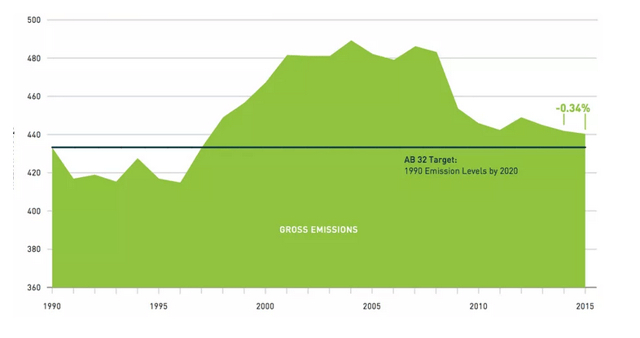
Fig 1. GHG emission trends in California from 1990-2015. Data source: California Air Resources Board. California Greenhouse Gas Inventory.
According to Samir & Marco, California is on the right track in reducing GHG emissions. Besides, California was the first state to adopt the LCFS (Low Carbon Fuel Standards) policy in the U.S.A. Studies establish that the LCFS policy has significantly reduced carbon dioxide emissions. Renewable energy, the preservation of water, and organic farming are feasible strategies for curbing GHG emissions.
Climate change is not just a global environmental health concern. It connects with all aspects of human life. Although it is a universal concern, studies focusing on specific areas are crucial in formulating the best-suited solutions. California serves as a critical instance of the effects of ongoing climate change. The crisis witnessed in California reminds the world of the need to embrace sustainability and preserve our environment. Fighting climate change requires innovation, strategy, and collaboration.
Works Cited
Aldaron Laird, Humboldt Bay: Shoreline Inventory, Mapping, and Sea Level Rise Vulnerability Assessment, Trinity Associates, 2013.
Bennet, Brett M., and Gregory A. Barton. “The enduring link between forests and rain: a historical perspective on emergent science and policy discussions.” (2018).
Chang, Heejun, and Matthew Ryan Bonnette. “Climate change and water‐related ecosystem services: impacts of drought in California, USA.” Ecosystem Health and Sustainability 2.12 (2016): e01254.
Ganesh, Chandrakala, and Jason A. Smith. “Climate change, public health, and policy: A California case study.” American journal of public health 108.S2 (2018): S114-S119.
Gorte, Ross W., and Pervaze A. Sheikh. “Deforestation and climate change.” (2010).
Huseynov, Samir & Palma, Marco. Does California’s Low Carbon Fuel Standards reduce carbon dioxide emissions?,.10.1371 (2018) journal.pone.0203167.
Liu, J.C., Mickley, L.J., Sulprizio, M.P. et al. Particulate air pollution from wildfires in the Western US under climate change. Climatic Change 138, 655–666 (2016). https://doi.org/10.1007/s10584-016-1762-6s
Ren, Diandong; Leslie, Lance & Duan Qingyun. “Landslides Caused Deforestation.” InTech. (2012). May 16, 2016. Available from: http://www.intechopen.com/books/deforestation-around-the-world/landslides-caused-deforestation
Roberts, David. “California Has A Climate Problem, And Its Name Is Cars”. Vox, 2020, https://www.vox.com/energy-and-environment/2017/8/22/16177820/california-transportation. Accessed 5 Dec 2020.
Rust, Sussane. “How Climate Change Is Fueling Record-Breaking California Wildfires, Heat And Smog”. Los Angeles Times, 2020, https://www.latimes.com/california/story/2020-09-13/climate-change-wildfires-california-west-coast. Accessed 5 Dec 2020.
Seymour, Frances, and Nancy L. Harris. “Reducing tropical deforestation.” Science 365.6455 (2019): 756-757.


