The Good Shepherd is a mosaic originating from 425 AD that adorns the entrance of Ravenna, Italy’s Mausoleum of Galla Placidia. Consider the framing mechanism of circles, lunettes, and lines in this artwork, containing miniature characters and narrative sequences. It can be observed that the mosaic is lacking tesserae that depict the stone ceiling. This is the result of a series of earthquakes2. This form of pictorial field structuring is a form of décor that is often seen in modern private residences, such as those in Pompeii and Ostia. Furthermore, how the figures are portrayed, frontal, with just a few subtle accents in the drapery and a focus on motions, is characteristic of late Roman art–once again, no unique Christian style emerges at this moment (but the subject matter is Christian). This essay will discuss the significance of The Good Shepherd mosaic in early Christian art.
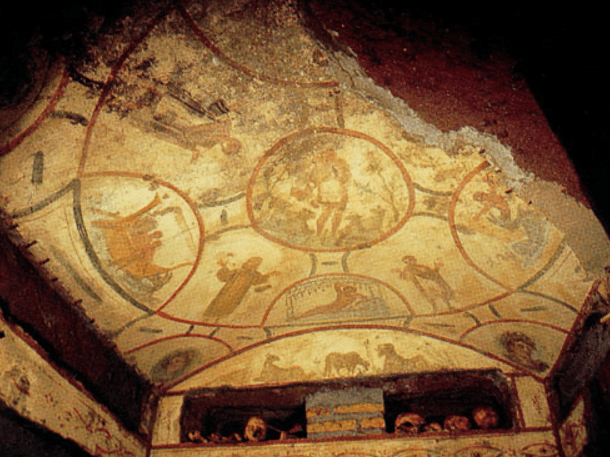
The pictures’ overall meaning is hopeful and centered on salvation. The center circle depicts the Good Shepherd, one of the most prominent motifs in early Christian art1. However, the image of a shepherd is not predominantly Christian. Indeed, it has a long Graeco-Roman history: bucolic representations of shepherds tending their flocks were popular wall decorations in Roman homes and served as inspiration for ancient Greek sculptures[1]. However, for Christians, the shepherd image had a symbolic connotation. In other words, the picture was not created by Christians but was reinterpreted biblically[2]. God is characterized as a shepherd in Psalm 22, and Christ himself refers to himself as a shepherd in the New Testament. The picture references a textual source and a metaphor for the content beyond the visual plane.
Lunettes on the flanks of the Good shepherd depict significant scenes from the old testament of Jonah’s encounter with the Whale in a clockwise manner. Jonah was hurled down the ship (on the left), was swallowed by a whale, and sat in its belly for three days, and later (right) emerged safely on the land reclining underneath a gourd and pondering redemption (bottom). This was a common topic adopted from the Hebrew Bible by Christians (Old Testament). It fits this funeral setting since Jonah, who is symbolically dead in the Whale’s belly, is returned to life by the Grace of God, motivating Christians to look forward to a similarly positive conclusion to their lives[3]. Additionally, Jonah is seen as a prefiguration of Christ’s death and resurrection in this passage.
Comparing the Old and New Testaments is a relatively frequent method of reading the scriptures. Theologians in the early centuries looked for events in the Old Testament that “prefigured” the arrival of Christ or for persons who were a “type” of Christ3. We can observe in this catacomb painting that typology (the search for Christ types) was not limited to literary interpretation but also happened in art. This comparison approach to picture interpretation is unique to Christian art; it is not seen in pagan or Jewish art. Early Christian art, in this sense, is Roman in style but Christian in the subject matter.
Bibliography
[1]Stokstad, Marilyn, and Michael Watt Cothren. 2018. Art history.
[2] Zimmermann, Norbert. “Catacomb Painting and the Rise of Christian Iconography in Funerary Art.” In The Routledge Handbook of Early Christian Art, pp. 21-38. Routledge, 2018.
[3] Zimmermann, Norbert. “Catacomb Painting and the Rise of Christian Iconography in Funerary Art.” 2018.


