All human beings are social regardless of racial, cultural, and geographical differences. At some point in life, everyone gets an opportunity to relate with another person or a group of people. Relationships are a critical part of growth and well-being to humans. Friendships and relationships start from childhood, where a child learns how to interact accordingly with the parents, siblings, and fellow children. As one grows, relations become more complex, forcing an individual to conform to certain standards to relate or become acceptable to a specific person or group. Apart from socialization and interaction, relations form a crucial part of a person’s identity, which explains why humans place so much importance on them. Human relations are multifaceted and exist in different dimensions.
Typically, friendships are vital in forming identity and interdependence. Romantic relationships are intimate and aim to establish mental and emotional stability. Unlike friendships, romantic relationships involve the formation of stronger psychological and biological ties. Humans often adopt certain traits and habits to fit comfortably into relationships. In this context, they strive to align themselves with people they relate to. This is called self-expansion. According to Mattingly et al. (2019), self-expansion is a situation where an individual desires or longs to enhance his/her values, power, interests, and efficiency.
The Self-expansion Theory
Theoretical perspectives are always crucial in explaining various phenomena. As noted by Mattingly & Lewandowski (2013), the self-expansion theory asserts that it is essential for people or an individual to expand their sense of self to be content and grow in their lives. Individual self-expansion is vital for human growth. Due to that, individuals often find themselves forming new relations or engaging in unfamiliar and creative activities to keep that feeling alive.
The model: the motivational principle and inclusion of the other in the self
According to Mattingly & Lewandowski (2013), the model encompasses two critical principles. Firstly, it entails an individual’s desire to expand and grow. This aspect relies on the notion that humans naturally desire to develop and acquire particular traits in life. The need for self-actualization and satisfaction motivates individuals to expand, grow, and amass resources for addressing their needs. As noted by Aaron, relationships are a crucial source of self-growth and expansion. In this context, when a person forms a romantic relationship, their sense of self acquires an apportion of their partner’s characteristics. Typically, a relationship with a person with a different character spurs the motivation to grow and expand. According to …., love emanates as a result of the association.
The second tenet of self entails the inclusion of other/s in self. For instance, when a person enters into a romantic relationship or any relationship with others, they are more likely to include their values, attitudes, and perspectives into those belonging to the other person. -quite often, this occurrence leads to overlapping characters of self and others (Aron et al. 2013). Quite often, if the other person makes their resources available, it becomes easier for them to believe they also belong to them. This situation fosters inclusion and a mixture of identities in a relationship. In this context, the other becomes a significant part of the self. In exploring this principle, Aron and Aron experimented by giving money to the subjects and letting them allocate the funds to friends, partners, and strangers. Through the observations made. Their work revealed that it was easier for subjects to give away money to their friends and partners than strangers. According to this principle, most people view their partners and friends more like parts of themselves, and hence, they are more likely to help them or be influenced by their experiences (Xu et al., 2016). Additionally, they view their partner’s resources as theirs.
Aron, Aron & Smollan (1992), developed a technique for measuring the inclusion of other in self. It consisted of small circles that would indicate how the values and perceptions of a couple overlap during their relationship. In three months, participants used a pair of circles to symbolize how their perspectives, emotions, and values connected, as shown in the figure below.
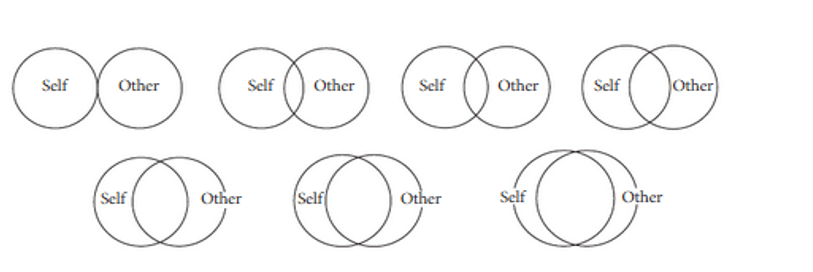
Fig 1.1. The inclusion of the “other in self” scale by ( Aron. A, Aron. E & Smollan,1992).Journal of Social and Personal Relationships, vol. 37.2. 2020.
As noted by Aron and Aron, this technique is also useful in measuring satisfaction among couples. Operationally, the overlapping of the circles signified closeness and that the relationship had a high inclusion of self in others. A space between the two rings indicates that the partners may not be so close and only share a few values, resources, and perspectives (Xu et al. 2016). This measurement is useful in indicating satisfaction in a relationship. According to Aron et al. (2013), the measure is vital in examining the inclusion of self in social groups such as the community. In recent years, this scale has developed to use a scale of 0-100.
As noted by Aron et al. (2013), the first phases of a relationship are denoted by high motivation as partners engage in innovative activities together. With time, it is challenging to execute these activities. This situation results in low motivation and a decline in satisfaction in the relationship.
Benefits of self-expansion to relationship growth
From both motivational and inclusive perspectives, self-expansion holds numerous benefits for relationships. Firstly, it stimulates the brain by developing positive emotions, relaxation, and optimism (Xu et al., 2011). Secondly, it fosters an intrinsic sense of self-motivation. Apart from relationships, many other activities are useful in enhancing self-efficacy (Mattingly & Lewandowski, 2013). Besides, self-expansion allows for the development of community relations. By including self in others, people expand networks by making friends with his/her partner’s friends. Apart from online social media, this creates an opportunity for couples to interact and make friends with others. Nowadays, this occurs across popular online social platforms like Facebook, where friends post pictures and tag mutual friends. Secondly, self-expansion enables us to maintain long-term relationships. One crucial indicator of a lasting relationship is the element of self-expansion by both partners. Typically, the higher the inclusion of others in self, the longer the relationship is meant to last. Thirdly, it fosters positive concerns among partners in a relationship (Schindler, 2014). In this context, partners admire and view one another as a reward in the relationship. Also, self-expansion helps couples in gaining a better understanding of each other. When partners understand each other well, their interactions are better and exciting. As stated, self-expansion involves including the self in others (Welker et al. 2014). Using this principle, partners will easily appreciate and celebrate either person’s achievements without perceiving it as a competition.
Ways of incorporating self-expansion in relationships
Like any other beneficial trait, self-expansion in a relationship requires the correct application to bear the desired benefits. Xu et al. (2016) noted that self-expansion is fundamental for relationships. However, it is affected by other dynamics like personal differences and lack of innovation. One crucial way of incorporating self-expansion in relationships is by engaging in novel activities together as a couple. This method holds many benefits for a couple. Firstly, it eliminates boredom and adds excitement to the relationship. Research and studies indicate that couples who engage in exciting activities experience excitement, satisfaction, and appreciation for each other.
Besides, these activities allow partners to understand one another better and develop ways to cover one another’s weaknesses. In selecting novel activities, it is crucial to pay keen attention to individual differences, the type of activities, and be alert to avoid loss of interest and boredom that may set in due to the factors stated. Some self-expression activities include vacations, short technical courses, and brainstorming (Xu et al. 2016). Apart from engaging in activities as a couple, it is critical to engage in self-expansion activities as an individual. Partner motivation plays a vital role in these activities. Unresponsiveness and inactivity lead to boredom and loss of interest in self-expanding activities.
Conclusion
Quintessentially, self-expansion fosters excitement, satisfaction, and stability in a relationship. However, it sometimes harms the partners when the relationship ends. Due to the inclusion of other partner’s values in self, partners who are too involved in a relationship are likely to experience psychological anguish and emotional distress when a relationship ends. Also, partners who suffer from anxiety often experience emotional strain, pessimistic perceptions of self, and low self-esteem. Recovering from such situations requires a person to re-establish themselves. This process includes developing a renewed sense of self and adopting other feasible coping strategies. Additionally, individuals need to retain beneficial attitudes, character, and values acquired in the previous relationship for a faster and more permanent recovery.
.
Reference
Aron, A., Aron E. N., & Smollan, D. (1992). Inclusion of others in the self scale and the structure of interpersonal closeness. Journal of Personality and Social Psychology, 63, 596-612.
Aron, A., Lewandowski, G.W. Jr., Mashek, D., & Aron, E.N. (2013). The self-expansion model of motivation and cognition in close relationships. In J. A. Simpson & L.
Campbell (Eds.) The Oxford Handbook of close relationships (pp. 90-115). New York: Oxford University Press.
Dys-Steenbergen, O., Wright, S. C., & Aron, A. (2016). Self-expansion motivation improves cross-group interactions and enhances self-growth. Group Processes & Intergroup Relations, 19(1), 60-71.
Mattingly, B.A., & Lewandowski, G.W. Jr. (2013). An expanded self is a more capable self: The association between self-concept size and self-efficacy. Self and Identity, 12, 621-634. doi:10.1080/15298868.2012.718863
Schindler, I., Paech, J., & Löwenbrück, F. (2014). Linking admiration and adoration to self-expansion: Different ways to enhance one’s potential. Cognition and Emotion. Epub ahead of print. doi:10.1080/02699931.2014.903230
Welker, K.M., Baker, L., Padilla, A., Holmes, H., Aron, A., & Slatcher, R.B. (2014). Effects of self-disclosure and responsiveness between couples on passionate love within couples. Personal Relationships, 21, 692-708. doi:10.1111/pere.12058
Xu, X., Aron, A., Brown, L., Cao, G., Feng, T., & Weng, X. (2011). Reward and motivation systems: A brain mapping study of early-stage intense romantic love in Chinese participants. Human Brain Mapping, 32, 249-257
Xu, X., Lewandowski, G. W., & Aron, A. (2016). The self-expansion model and optimal relationship development. In Positive Approaches to Optimal Relationship Development (pp. 79–100). Cambridge University Press. https://doi.org/10.1017/cbo9781316212653.005
Xu, X., Aron, A., Brown, L., Cao, G., Feng, T., & Weng, X. (2011). Reward and motivation systems: A brain mapping study of early-stage intense romantic love in Chinese participants. Human Brain Mapping, 32, 249-257


