The Korean War was a military dispute between the Democratic People’s Republic of North Korea and the Republic of Korea (South Korea) that lasted for three years (1950-1953)(Kim). Throughout history, scholars have raised questions about why the United Nation’s military support to the South consisted of a large portion of United States forces. Why did other powerful states not get involved as much?
After World War II, U.S embarked on the containment policy intending to curb the spread of communism. In this light, U.S had to move fast to eliminate the threat presented by North Korea and her “sponsor”-the Soviet Union.Additionally, the United Nations needed to get involved in the war to protect its trade relations within the region. Suppose South Korea would lose Japan (a major trading partner to the U.S). Such a situation would be detrimental to the United States’ welfare.
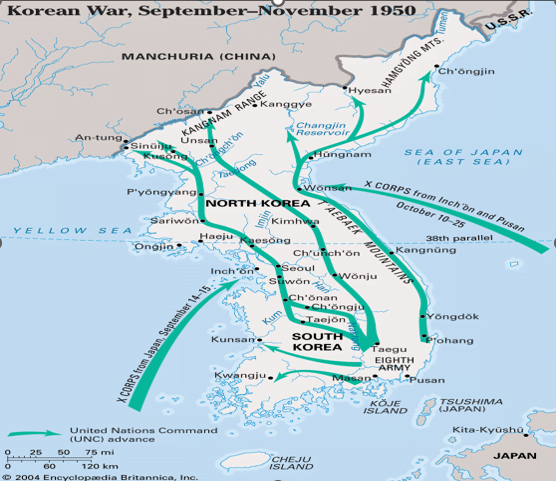
Fig.1: The United Nations Command’s advancement against the North Korean invasion in 1950.
Source: https://www.britannica.com/event/Korean-War
There are several reasons why the Korean War was more of a police action than a conventional military encounter for the United States. Firstly, the United States was not in a favourable position to pursue war due to the limitations inflicted by World War II engagements. Besides, the United States fought the war under the guise of the United Nations because it was not directly involved in the conflict. Additionally, the United States did not aim to achieve victory but rather took advantage of the Korean situation to tame communism.
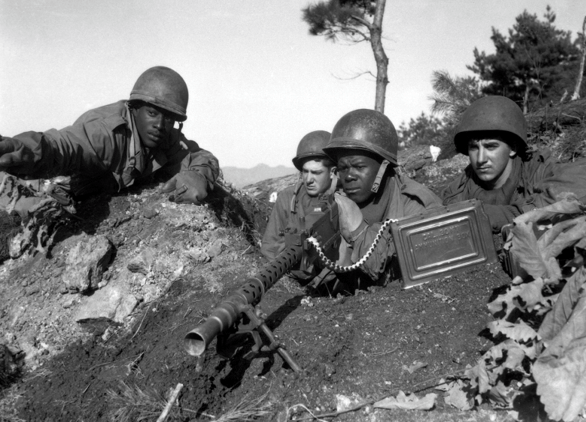
Fig 1.2 American soldiers in battle during the Korean War.
Source: https://www.britannica.com/event/Korean-War
According to Stoker, the Korean War ended in a truce between the United Nations and North Korea, and China. Although a peace agreement between the two territories was not the primary goal for both sides, it emerged after realizing that unification would be impossible. Even though the armistice still exists today, the two countries have a strained relationship and subtle antagonism fuelled by Russia and the United States.
Events that escalated the Cold War.
The Cold War was a profound rivalry between U.S and the Soviet Union. After the second world war, both countries emerged as the most powerful countries, each adopting a different economic and political dispensation. The United States practised capitalism, while the Soviet Union advocated communism and a socialistic political policy (Herzog).
The division of Germany into East and West Germany is among the primary factors that escalated the Cold war. After World War II and Germany’s division between allied powers and the Soviet Union, the latter set out to spread and adopt communist policies that were contrary to the political direction in West Germany. Such precedence created a solid foundation for the cold war (Westad).
By observing the Soviet Union’s influence across Europe and Asia, the United States under President Harry Truman adopted the containment policy (Lorenzini). This policy aimed to curb the spread of communism or the “Red scare.” In executing this policy, the U.S. granted humanitarian and military aid to various nations like Greece, Turkey, and South Korea to lure them away from the trap of communism and Soviet influence.
In light of the escalating tensions, both countries became increasingly aware of an imminent war. In preparing themselves for this situation, the United States and the Soviets embarked on an arms race. Each nation excessively increased its military personnel and machinery like ships, planes, tanks, and small arms. Additionally, this period witnessed the development of the atomic bomb by the Soviet Union in 1947, which prompted the United States to create and test the hydrogen bomb in 1952 (Green). Although the arms race escalated the Cold War between the two nations, it presented the threat of a global-scale nuclear conflict that would bear adverse implications for humanity.
Works Cited
Green, Brendan Rittenhouse. The Revolution that Failed: Nuclear Competition, Arms Control, and the Cold War. Cambridge University Press, 2020.
Herzog, Dagmar. Cold War Freud. Cambridge University Press, 2017.
Kim, Kevin Y. “The interrogation rooms of the Korean War: The untold history.” (2019): 819-820.
Lorenzini, Sara. Global development: a Cold War history. Princeton University Press, 2019.
Stoker, D. (2019). Why America Loses Wars: Limited War and US Strategy from the Korean War to the Present. Cambridge University Press.


