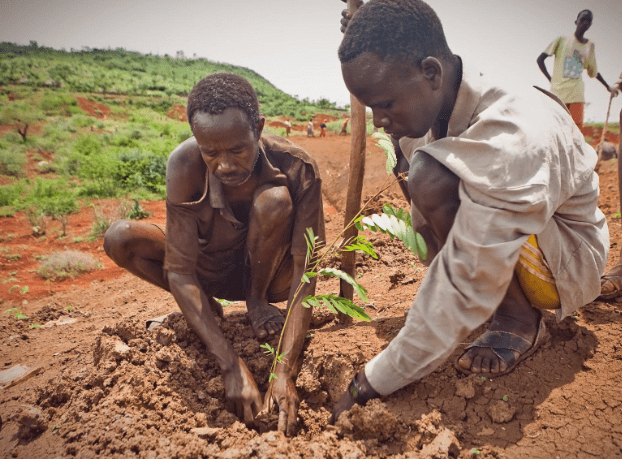
Senegal is a country situated in the western part of Africa with 14 million people, per UNDP’s record in 2013. The country is dominated by Muslim adults and at least twenty tribes. Currently, 55% of the population, more than half, stays in rural areas. Consequently, poverty levels in the rural set-up are increasingly affecting people as a result of various factors associated with poverty, the most prevalent one being inequality, according to the World Bank Report of 2011. In this regard, the role of forestry in eradicating poverty has gained momentum worldwide, and it is among one of the Millennium Developmental Goals. Various studies have shown that through forestry, communities can have food security (Appanah, 2004). Therefore, this report provides insights aimed at curbing poverty levels in the rural Tambacounda location by initiating practices of tree planting with the help of ECOSIA and other relevant key stakeholders.
Under the initiative of Trees for the Future (TREES) and alleviation of poverty in the rural Tambacounda region in Senegal, it is important to liars with Ecosia by developing a contract that will last for eight months to support the activities of tree planting. This works within the motive that Ecosia had announced, creating a partnership with West African countries purposely for planting trees (Kendall, 2013). The rationale underpinning this initiative was to combat climate change, revive degraded lands, and improve people’s living standards. This was geared towards meeting one of Ecosia’s agenda of planting trees totalling up to one billion by 2020. Besides, it is committed to sponsoring various projects aligning with its West African initiative by offering funds to support tree-planting activities. A practical example is the Kaffrine new forest site project in Senegal supported by Ecosia, which aims to plant up to 1.2 million trees within 46 months (Kendall, 2013).
To eradicate poverty in the rural Tambacounda region, tree planting will require huge funds to carry out various activities, such as buying seedlings, equipment, and human resources, among other credentials. One of the main strategies to ensure these needs are met is to make agreements with Ecosia to offer support for our activities.
One of the main tactics to convince the company to enter into this contract agreement is using and promoting its search engine in UNSW society. The students will be encouraged to browse the internet using the Ecosia search engine. Subsequently, the funds generated by Ecosia through searches done by UNSW would be used to enhance the activities of this project. To ensure this tactic is effective, a series of campaigns will be developed to convince UNSW society of the importance of supporting this project. Further details will be offered to the students through briefing in gatherings and sharing the information through social media.
Ecosia is a website search engine that has a huge impact on forestry through the use of its profits to sponsor reforestation activities in areas that seem to have been encroached upon. The company depends on Bing and Yahoo search engines to display its algorithms. Also, it is based on a model of ads displayed for advertisements, and the company receives 0.0005 dollars for every ad viewed. Ecosia has over 7 million active users in France, Germany, the United States, and the United Kingdom. Which accelerates its high rates of profits.
Therefore, Ecosia and UNSW will agree to proscribe the use of Google search engines and make the Ecosia search engine the main platform to be used by students. On the other hand, the administrators of UNSW will agree on contract terms to make the Ecosia search engine the default software in the school’s computer appliances by the end of 2020.
The implication of making the Ecosia search engine a default software will help maximize the review of ads that will boost the money generated from the UNSW since Ecosia applies the business enterprise model. Also, the UNSW society may use this search engine to gain familiarity with it. One of the most unique things about this Ecosia search engine is that it does not work towards maximizing its profits but rather generates revenue to support tree planting using non-profitable platforms such as Yahoo and Bing.
Further meetings will be conducted with UNSW staff to elaborate further on the benefits associated with using the Ecosia search engine through critical analysis of the principles underpinning its operations, functions, and where it is more readily reliable. One of them is that it is efficient, economical, and non-profit oriented, which is a cost-effective indication.
To make Ecosia the default search engine instead of Google, a technician will be hired to fix the Ecosia search engine on all computers within the school and further provide more convincing information to the students on the effectiveness of applying it.
Various in-service programs and training concept workshops will be offered by the Ecosia technicians from 4-5 in the evening hours of the working days of the week. By doing so, every individual within the institution will have a glimpse of how to use the Ecosia search engine in daily activities instead of the Google search engine. When everyone started using the Ecosia search engine UNSW, the revenue generated enough to support the planting of trees in the rural Tambacounda region.
Another strategy to ensure the application of the Ecosia search engine is being used more often is convincing students to use the Ecosia Search engine as a default browser on their phones and laptops instead of the Google search engine. The tactic for doing this is installing Ecosia software for free on every student’s device. Secondly, the UNSW will meet with students to reemphasize the same.
The promotion will increase the number of students using Ecosia on their devices. The promotion can be increased to 1000 dollars to keep track of more Ecosia users. Besides offering incentives, the Ecosia company would employ a few students actively using Ecosia search more often. This tactic will promote the use of this search engine.
As many people shift towards using the Ecosia search engine, more trees will be planted due to more revenue generation. Ecosia has initiated several projects in various parts of Western Africa using the forest garden method. This approach attempts to develop and increase income-generating opportunities and sustain food security by restoring green tree cover. The forest garden includes various types of trees that will provide a sustainable source of firewood and food.
However, there is a need to provide a broad array of activities and agendas that will make sense for the Ecosia company to deliver its services more readily than expected. Some of the activities that will be handed over to the company include planting over 1.3 million trees across the regions of rural Tambacounda within eight months. Some expenditures will be summarized appropriately and submitted for the company to verify. Quantifying the costs and benefits of this project to the community in alleviating poverty will also be offered to the company.
In the rural Tambacounda region, the project will target the communities living within the locality. The interest in reaching out to this community is mainly to enhance their capabilities in decision-making, strengthen their rights, and increase their participatory levels. This is because trees can only reduce poverty when people are intelligent in making substantive decisions concerning forestry. In most cases, poor people are powerless but responsible for managing their environments and lives. To ensure the community participates in this project, it is necessary to educate them on the importance of planting trees, especially in eradicating poverty experienced among the community members.
It is also important to involve the local government in fostering tree-planting activities in the Tambacounda region. The local government will assist in initiating this project by creating awareness and enforcing policies that restrict the cutting down of trees. Besides, the local government may provide additional funds for purchasing seedlings and hiring manpower to implement this project effectively.
Some established strategies to reduce poverty vulnerability in the Tambacounda region include developing safety nets. For instance, forest products can be the key to coping with difficult times. Regions within the Tambacounda that experience extreme poverty can access forest resources since it provides an important buffer to poverty vulnerability. However, the exploitation of forest resources must follow certain established precautions to avoid overexploitation of the existing forest. Most parts of Senegal are vulnerable to diverse arid and semi-arid climates. In this regard, communities should avoid overlying on forest products and look for alternatives. This is in line with the Sustainable Developmental Goals (SDGs).
Tree planting is an effective intervention in eradicating poverty, especially in rural areas. This is due to the impact of trees, such as rainfall, soil erosion control, tree products, and many more. By extension, forestry enhances agricultural practices since it acts as a windbreaker for crops vulnerable to strong winds, such as coffee. The products obtained from plants can be used to earn a living for the local community staying around. For instance, selling timber and fruits. Also, some trees can be used as medicine instead of buying from the market. Trees provide a better microclimate that is conducive to agricultural practices. Thus, communities staying in such areas live a better life since they can get food from the farms.
References
Appanah, Y. (2004). FORESTS FOR POVERTY REDUCTION : Opportunities with Clean Development Mechanism, Environmental Services and Biodiversity.https://agris.fao.org/search/en/providers/122621/records/6473a5112437ad1e5b9228f2
Bukenya, M. (2008). Potential Contribution of Small-scale Tree Planting to Poverty Reduction in Uganda. Livelihood and Awareness in Rural Communities, (August), 24–40. https://doi.org/10.5923/j.ijaf.20130307.08
Faruqi, S., Wu, A., Brolis, E., Anchodo Ortega, A., & Batista, A. (2018). The Business of Planting Trees.
Geller, S., & McConnell, R. (2006). Linking national forest programmes and poverty reduction strategies. Unasylva, 57(225), 56–62.
Green Climate Fund. (2017). Building the climate resilience of food insecure smallholder farmers through integrated management of climate risks (the R4 Rural Resilience Initiative). (November). Retrieved from https://www.greenclimate.fund/-/building-the-climate-resilience-of-food-insecure-smallholder-farmers-through-integrated-management-of-climate-risk-r4-in-senegal?inheritRedirect=true&redirect=%2Fwhat-we-do%2Fprojects-programmes%3Fp_p_id%3D122_INSTANCE_VKj2
Holden, S., Benin, S., Shiferaw, B., & Pender, J. (2003). Tree planting for poverty reduction in less-favoured areas of the Ethiopian highlands. Small-Scale Forestry, 2(1), 63–80. Retrieved from http://www.springerlink.com/index/9224814321674635.pdf
Kendall, G. (2013). Press release Press release. 2011(20130701), 32–33.
Leakey, R. R. B., Tchoundjeu, Z., Schreckenberg, K., Shackleton, S. E., & Shackleton, C. M. (2005). Agroforestry tree products (AFTPs): Targeting poverty reduction and enhanced livelihoods. International Journal of Agricultural Sustainability, 3(1), 1–23. https://doi.org/10.1080/14735903.2005.9684741
Mayers, J., & Vermeulen, S. (2002). Power from the Trees : How Good Forest National governance : International governance : Iied, (Johannesburg), 1–8.
Miller, D. C., Muñoz-Mora, J. C., & Christiaensen, L. (2017). Prevalence, economic contribution, and determinants of trees on farms across Sub-Saharan Africa. Forest Policy and Economics, 84(August), 47–61. https://doi.org/10.1016/j.forpol.2016.12.005
Ministry of Finance Planning and Economic Development. (2005). Uganda : Poverty Reduction Strategy Paper 2005. (05). Retrieved from http://www.imf.org/external/pubs/ft/scr/2005/cr05307.pdf
Monetary, I., August, F., Country, I. M. F., No, R., Reduction, P., Papers, S., … Services, P. (2010). Cameroon : Poverty Reduction Strategy Paper International Monetary Fund Washington, D . C . (10).
Ruch, T. J., Schmidt, N. H., Decker, J., & Kolbe, L. M. (2011). Ecosia–Who Cares About a Green Search Engine? 17th Americas Conference on Information Systems (AMCIS), 1–13.
World Food Programm (WFP). (2018). The R4 Rural Resilience Initiative. (January). Retrieved from https://www1.wfp.org/r4-rural-resilience-initiative


